

Atmospheric Chemistry and Physics ACP Award 2024
At the Swiss Geoscience meeting in Basel in November 2024, the ACP Award for Atmospheric Research was presented to Dominique Rust for her PhD thesis “Verification of halogenated greenhouse gas emissions by regional atmospheric observations in Europe”. Her work covers a wide range of methods, from precision measurements of gases to statistical data analysis. The award committee was particularly impressed by one part of her thesis work: In a tracer-release experiment she could quantify emissions from a fluorocarbon industry cluster and could show that effective abatement measures do reduce HFC emissions.
Immagine: ACP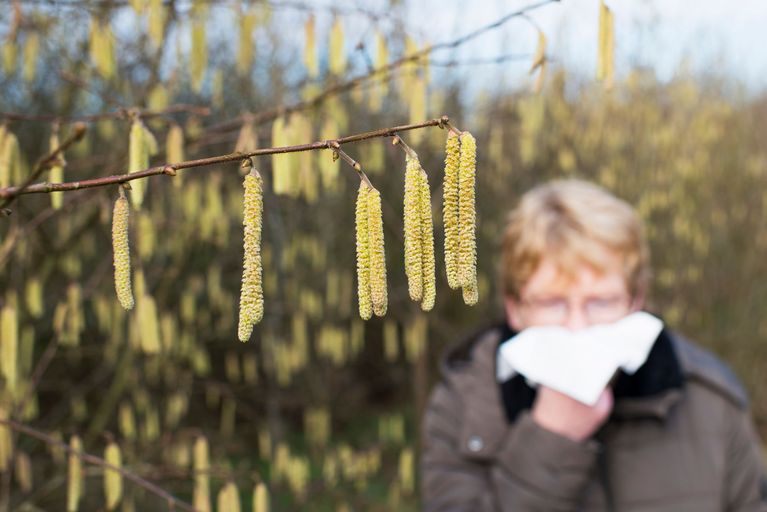
Il raffreddore da fieno è in aumento a causa del cambiamento climatico
Con il cambiamento climatico, la stagione del raffreddore da fieno si sta allungando, le concentrazioni di polline stanno aumentando e si stanno diffondendo piante invasive altamente allergizzanti. I ricercatori della Commissione svizzera di chimica e fisica dell'atmosfera (CPA), dell'Accademia svizzera di scienze naturali e di MeteoSvizzera hanno valutato e riassunto le conoscenze attuali in materia.
Immagine: stock.adobe.com/schulziePollen allergy and the impact of a changing climate
While hay fever was almost unheard of in Switzerland 100 years ago, at present, around 20 percent of the Swiss population suffers from pollen allergy. Importantly, climate change is causing an earlier onset and increased intensity of the pollen season for many allergenic plants. Climate change also fosters the spread of highly allergenic invasive plants like ragweed. Furthermore, the combined exposure to air pollution and pollen may worsen allergic reactions through increased sensitivity and increased pollen allergenicity. Scientists of the Swiss Commission for Atmospheric Chemistry and Physics provide an overview of pollen, hay fever, and how climate change is affecting both.
Immagine: CC BY-NC-ND
Atmospheric Chemistry and Physics ACP Award 2023
At the occasion of the Swiss Geoscience meeting in Mendrisio in November 2023, the ACP Award for Atmospheric Research was presented to Marina Friedel for her PhD thesis "The role of Arctic ozone in forcing Northern Hemispheric climate". Her work shows that the springtime Arctic ozone depletion causes surface anomalies across the Northern Hemisphere on both seasonal and multi-decadal timescales. Her results were recognised in the summary report of the 2022 WMO/UNEP Ozone Assessment.
Immagine: NASAAtmospheric Chemistry and Physics ACP Award 2022
At the occasion of the Swiss Geoscience meeting in Lausanne in November 2022, the ACP Award for Atmospheric Research was presented to Lea Beusch for her PhD thesis ‘MESMER – A Modular Earth System Model Emulator with Spatially Resolved Output’. In her thesis, she developed a regional Earth System Model (ESM) emulator, which is able to emulate the output of geographically-resolved ESMs, based on a given global temperature input. Lea Beusch demonstrated how MESMER can be used to recombine global and regional features of ESMs to cover a larger phase space with the emulator, potentially including observational constraints.
Immagine: NASA
2022 était un été normal du 21e siècle
Chaleur, sécheresse, risque d'incendie – les conditions comme celles de 2022 deviendront bientôt la norme avec le changement climatique. L'été 2022 sera même l’un des plus frais du 21e siècle si les émissions de gaz à effet de serre ne sont pas nettement réduites dans les prochaines décennies. C’est ce qu'écrivent des chercheurs sur le climat dans un chapitre supplémentaire qui vient d’être ajouté à la brochure « Hitze- und Trockensommer in der Schweiz » publiée en 2022.
Immagine: Gabriela Brändle, Agroscope
